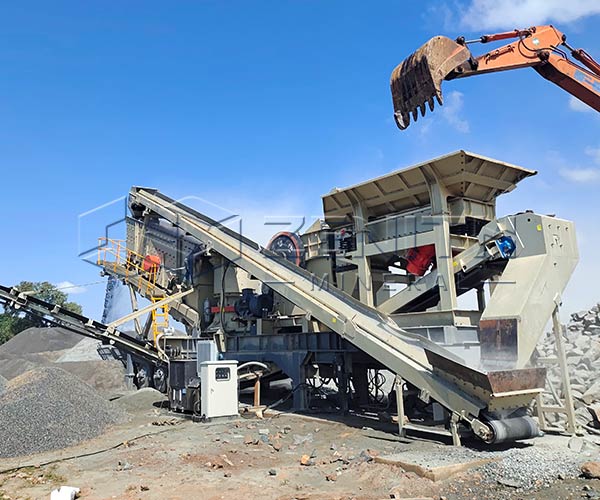
A stone crusher machine is an industrial device used to crush large rocks into smaller aggregates, gravel, or sand. It operates using mechanical energy to apply pressure, impact, or shear forces to rocks, breaking them into usable forms. These machines are essential in multiple industries, particularly mining, construction, and recycling.
In essence, stone crushers bridge the gap between raw rock extraction and the finished material needed for industrial use.
Mining operations require different crusher types depending on the hardness of the ore, desired particle size, and production capacity. Here is a detailed look at the main types:
Jaw crushers are primarily used for primary crushing, meaning they handle the largest rocks in a mining operation. They operate with two plates—one fixed and one moving—that compress the rock until it breaks.
Mining Use Case: Primary crushing of hard ores like iron or gold.
Average Capacity (TPH):50–800
Jaw crushers are ideal for small to large-scale mining operations that need to break down hard rock before secondary processing.
Cone crushers are typically used for secondary or tertiary crushing, providing finer output than jaw crushers. They employ a rotating cone inside a fixed outer shell, compressing rock until it fractures.
Mining Use Case: Secondary crushing for consistent sizing and preparation for fine grinding.
Average Capacity (TPH):100–500
Cone crushers are widely used in medium and large mines due to their efficiency and ability to handle continuous operation.
Impact crushers use high-speed rotating hammers or blow bars to fracture rock, relying on impact rather than compression. They are versatile machines, suitable for softer materials like limestone, sandstone, and medium-hard aggregates.
Mining Use Case: Crushing medium-hard aggregates in quarries or secondary processing for softer ores.
Average Capacity (TPH):75–600
Impact crushers are often preferred in construction aggregate production because they generate well-shaped stones suitable for concrete and asphalt.
These crushers are generally used in niche scenarios or for specialized mining outputs.
This table highlights the versatility and specialization of crushers depending on mining requirements.
The stone crusher market reflects a range of capacities, automation levels, and industrial needs. Mining operators can choose machines based on budget, output requirements, and ore characteristics.
These machines are typically manual or semi-automated and are cost-effective for miners starting operations.
Mid-range crushers balance performance and affordability, often featuring some automation, hydraulic operation, and higher efficiency for sustained operations.
High-end equipment offers maximum efficiency, minimal downtime, and advanced control systems, ideal for mines that require continuous, high-volume production.
Stone crusher prices vary by region due to local manufacturing, import costs, and market demand.
China and India offer cost-effective machinery suitable for small to mid-scale mining, while the US market caters more to high-capacity, technologically advanced plants.
We have jaw crushers, impact crushers, cone crushers, sand makers and so on.
Mon - Sun, 0:00 - 24:00
24h Online Service
© Zenith. All Rights Reserved. Designed by

 WhatsAPP 24h online service


 24h Online Chat


